Virginian Creeper - A self Clinging Climbing Plant
SEASONAL TIPS
Spring - Early Summer
Propagate Virginia Creeper and produce more plants by layering. Save some
to give to your friends or sell at plant sales.
Now is the time to prune Virginia Creeper.
Autumn-
Take cuttings of Virginia Creeper.
Admire the stunning display of magnificent autumn colour that Virginia
Creepers provide!
POPLUAR VARIETIES OF VIRGINIA CREEPER
P. Quinquefolia
P. Vitacea
P. Tricuspidata
MEDICINAL USE OF VIRGINIA CREEPER
Native Americans traditionally used Virginia Creeper as a herbal remedy for treating diarrhea, swelling and tetanus.
PLANT GUIDES
VIRGINIAN CREEPER (PARTHENOCISSUS QUINQUEFOLIA)
 Virginian
Creepers (Parthenocissus) are quick growing and hardy
self-clinging climbing plants, closely related to the vines.
Virginian
Creepers (Parthenocissus) are quick growing and hardy
self-clinging climbing plants, closely related to the vines.
They can reach heights of up to thirty metres. They are called Engelmann's Ivy in Canada and sometimes known as Virginia Ivy or five-leaved ivy.
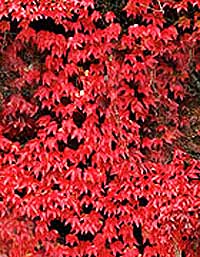
All Virginia Creepers colour magnificently with leaves turning to a deep red or burgundy before they drop their leaves in autumn.
VARIETIES OF VIRGINIA CREEPER
The most popular is the Small-leaved Virginian Creeper (Parthenocissus Tricuspidata) because of its neat habit and ability to climb a wall by little adhesive disks on its tendrils.
The True Virginian Creeper (Parthenocissus Quinquefolia) also climbs by adhesive disks on its tendrils, but has much larger leaves and is not so neat in habit.
The Common Virginian Creeper (Parthenocissus Vitacea) has no disks, only tendrils, so must be given a trellis, wires or some similar support to cling to.
GROWING AND PROPAGATING VIRGINIA CREEPER
Virginia Creeper will grow in any reasonable soil and prefer a sunny place, though will grow in shade.
Virginia Creeper can be increased by layering in late spring or early summer or by taking cuttings of well- ripened stems in autumn.
Grow Virginia creeper on a trellis to gett the look of an ivy covered wall, rememebering to keep it well trimmed.
PRUNING VIRGINIA CREEPER -WHEN TO PRUNE?
Regular pruning, best carried out in spring is required to control this vigorous climber. Virginia Creeper is very tolerant of hard pruning and it can be cut right back to its base.
VIRGINIA CREEPER FLOWERS AND BERRIES
Small, greenish flowers are produced in clusters during late spring.
Purple / black berries are produced in late summer - early autumn.
Virginia Creeper berries can be moderately toxic to mammals, including humans, as they contain oxalic acid. However the berries can provide an important source of winter food for birds.
REMOVING VIRGINIA CREEPER FROM WALLS
Because Virginia Creeper vines adhere to walls by adhesive disks rather than by invasive penetrating roots, they do not damage masonry - BUT trying to rip a Virginia Creeper vine from a wall will damage the wall's surface.
To prevent damage to walls the vine should be first killed. If the vine is cut from the root, the plant's adhesive pads will deteriorate in time and eventually release their grip, allowing you to remove the creeper with mininal damage to masonry.
VIRGINIA CREEPER AND WILDLIFE
Planting Virginia Creeper in your garden can create an attractive habitat for wildlife. Its thick foliage provides good cover for small animals and the vines provide birds with nesting places and perches. The berries of Virginia Creeper are eaten by many animals - especially birds, and the stems and leaves are eaten by many species of small mammals.
GARDENING ARTICLES ON GARDEN GROWER
What is Virginia Creeper? Advice about growing and planting Virginia Creeper Vines and Ivy to attract wildlife and birds. Varieties of Parthenocissus. How to remove Virginia Creeper from walls. When is the best time to prune a virginia creeper?