Hebe - a flowering evergreen shrub
SEASONAL TIPS
Spring - Pruning hebes - prune older or overgrown
Hebes
Remove the oldest stems that have become "twiggy"
Cut back other stems of the Hebe to around a quarter of their length.
Summer -
Make sure that Hebes are watered - especially new plants.
Check for greenfly and blackfly.
Autumn-
Remove flowers from Hebe Shrubs once they start to fade.
Protect Hebe cuttings from frost.
Plant out new Hebes
POPLUAR HEBE VARIETIES
Hebe Carl Teschner,(violet / blue flowers) Hebe Pingulfolia Pagei (white flowers)and Hebe Armstrongii are small varieties of Hebe suitable for growing in a rockery or as ground cover
One of the largest Hebes is Hebe Salicfolia. This Hebe can grow to over 10 feet or 2 metres in height.
A long flowering pink Hebe - Marjorie is a mid sized plant which makes a wonderful background for summer annuals in a flower border.
HEBE SOCIETIES
HEBE -A NATIVE SHRUB OF NEW ZEALAND
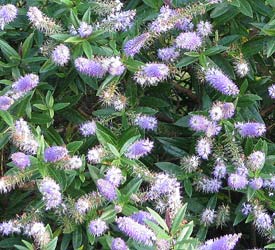 Hebe
(Evergreen Veronica) is an easy to grow flowering evergreen shrub
native to New Zealand and South America.
Hebe
(Evergreen Veronica) is an easy to grow flowering evergreen shrub
native to New Zealand and South America.
Hebe plants come in many sizes ranging from dwarf shrubs, suitable for planting in patio pots and rockeries, to large hebe plants that are perfect for planting in a large garden.
Many varieties of Hebe flower throughout summer and autumn - some varieties of Hebe flower during the winter.
Although mostly hardy, a cold English winter can kill some types of Hebe plants.
Hebes especially need to be protected from strong winds. The variegated-leafed Hebes seem to be amongst those most affected by cold winds and wintery weather.
Hebes are easy to propagate from cuttings.
FLOWERS ON A HEBE PLANT
The flowers on a Hebe shrub are small and grouped together in spikes. The colours of Hebe flowers range from white through pink, blue, lilac and purple to bright crimsons.
FOLIAGE
The leaves provide attractive year round foliage with different colours including silver and green, grey, violet, burgundy, bronze and red.
BUTTERFLIES
This delightful shrub has flowers which will attract butterflies and bees to your garden.
WHERE TO PLANT A HEBE SHRUB
A Hebe is a good all year round foliage plant. Its flowers can provide colour throughout all growing seasons.
Grown in mixed plantings of summer annuals the flowers of a Hebe add to the floral display whilst the shape and form of the bush give a sense of stability.
Hebe can be grown as an informal hedge - but if clipped back too hard it will not produce so many flowers.
The smaller hebes make good ground cover plants or add interest to a rockery.
A Hebe should be planted in a well drained soil and, if possible, in a position protected from wind.
HOW TO PLANT A HEBE
- Before planting a Hebe soak the roots in water
- Dig a hole twice as wide as the container that the Hebe is in.
- Add a spadeful of compost and some general purpose fertiliser to the soil taken from the hole that you have dug.
- Remove the plant from the pot - tap the sides and base of the container to release the Hebe.
- Place the hebe plant into the hole.
- Fill in the space around the plant with the soil and compost mixture and gently firm with your fingers or tread in.
- Water in with plenty of water.
- Mulch around the base of the plant to help to conserve moisture.
GARDENING ARTICLES AND ADVICE ON GARDEN GROWER
| | Grow Your own Olives | Grow Onions From Sets | Salad Radishes |When to Prune Roses | Buying Storage Buildings in California | Toadflax aka Linaria | Lawnmower Sales Devon.shtml | |
How to grow Hebe an evergreen flowering shrub> Grow as a hedging plant or as a feature in a mixed shrubbery